Resin Transfer Moulding (RTM)
- Michael Causon (School of Mathematical Sciences, University of Nottingham)
- Andreas Endruweit (Composites Group, Faculty of Engineering, University of Nottingham)
- Mikhail Matveev (Composites Group, Faculty of Engineering, University of Nottingham)
- Michael Tretyakov (School of Mathematical Sciences, University of Nottingham)
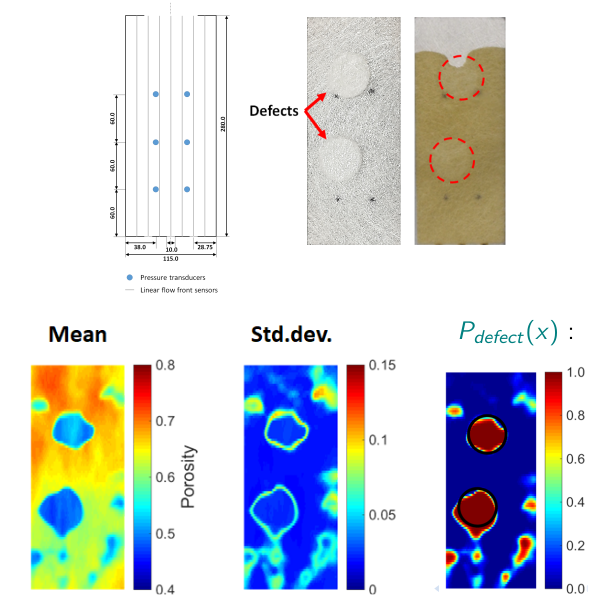
Much of my work has been motivated by the application of inverse problem methodology to Resin Transfer Moulding (RTM). In particular, the goal is to characterise local variations in permeability and porosity within a fibre reinforcement using in-process measurements, such as pressure data and resin front position, collected during the infusion process.
Our initial work applied Ensemble Kalman Inversion (EKI) to infer permeability fields and compared its performance with Sequential Monte Carlo methods using synthetic experiments [1]. We subsequently combined EKI with level-set parameterisations and demonstrated, using real experimental data, that this approach can be highly effective for identifying defects in composite materials , see Figure 1.
More recently, we have explored deep learning approaches to accelerate the inversion process, motivated by the need for real-time inference in practical applications in order to inform active control strategies. In [2], we employed a shallow neural network to learn the forward map over a parametrised domain consisting of 81 zones and to estimate spatially varying permeability and porosity. To extend this approach to the infinite-dimensional setting, where entire functions must be inferred, we developed a DeepONet-based surrogate model in [3], which enables efficient emulation of the forward map and facilitates fast Bayesian inversion.