Electrical Resistivity Tomography
👥 Collaborators
- Andy Binley (Lancaster University)
- Michael Tso (UK Centre for Ecology and Hydrology)
- Oliver Kuras (British Geological Survey)
- Paul Wilkinson (British Geological Survey)
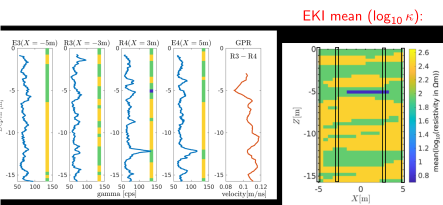
We have applied Ensemble Kalman Inversion (EKI) combined with level-set parameterizations to infer subsurface electrical properties from Electrical Resistivity Tomography (ERT) data [1], and subsequently extended this framework to Induced Polarization measurements [2]. Our numerical experiments demonstrate that, in contrast to standard smoothness-constrained optimization approaches, the level-set formulation enables more accurate identification of interfaces between different lithofacies.
References
[1]
C.-H. M. Tso, M. Iglesias, P. Wilkinson, O. Kuras, J. Chambers, and A. Binley, “Efficient multiscale imaging of subsurface resistivity with uncertainty quantification using ensemble kalman inversion,” Geophysical Journal International, vol. 225, no. 2, pp. 887–905, Jan. 2021, doi: 10.1093/gji/ggab013.
[2]
C.-H. M. Tso, M. Iglesias, and A. Binley, “Ensemble kalman inversion of induced polarization data,” Geophysical Journal International, vol. 236, no. 3, pp. 1877–1900, Jan. 2024, doi: 10.1093/gji/ggae012.