Magnetic Resonance Elastography (MRE)
👥 Collaborators
- Susan Francis (Sir Peter Mansfield Imaging Centre, University of Nottingham)
- Michael Tretyakov (School of Mathematical Sciences, University of Nottingham)
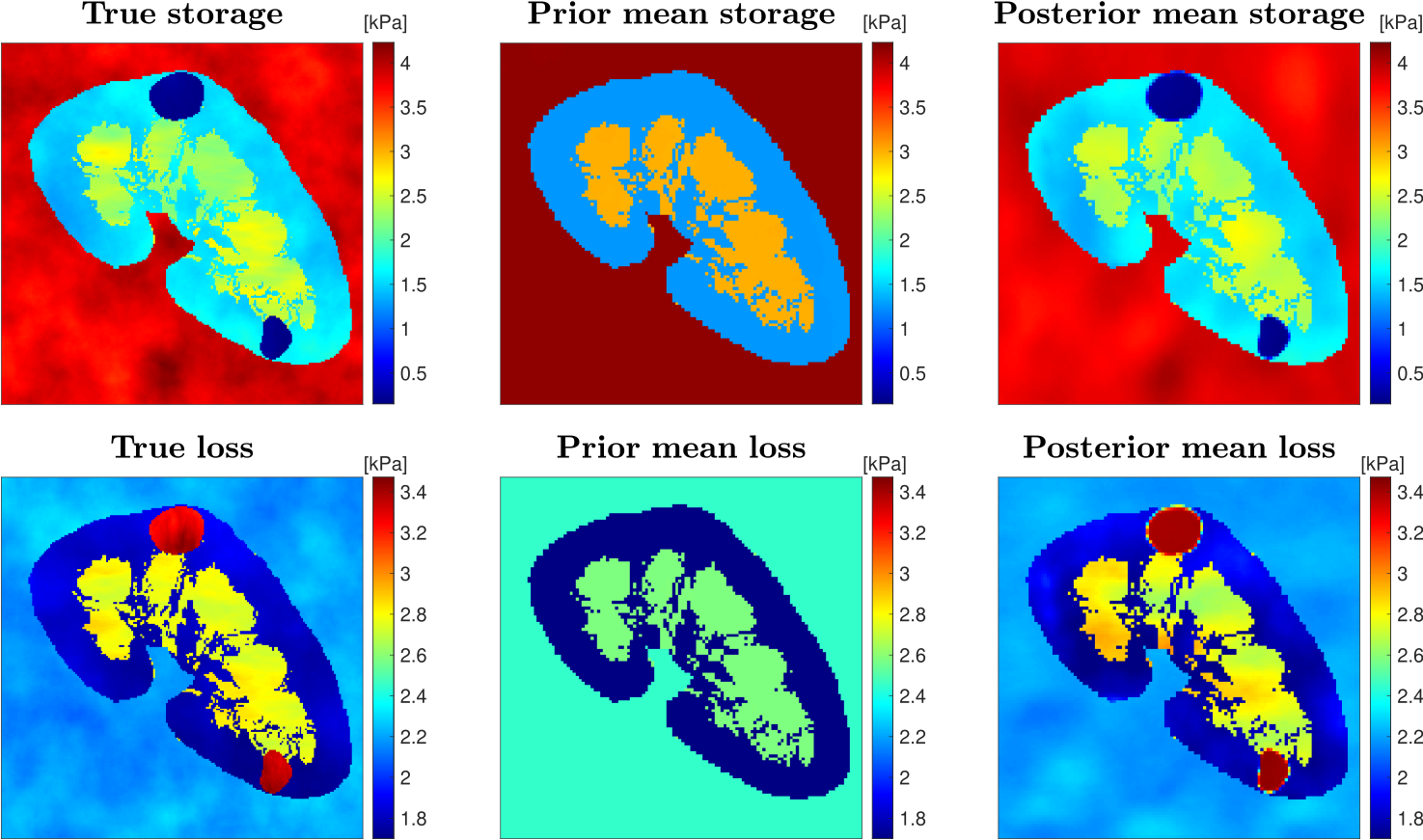
MRE is a non-invasive, radiation-free imaging technique designed to reconstruct the viscoelastic properties of biological tissue. A mechanical driver is placed on the patient to induce shear waves at a prescribed frequency. The resulting displacement fields are imaged using Magnetic Resonance Imaging, and these measured displacements are subsequently inverted to recover the tissue storage and loss moduli. In the work of [1], we employed Ensemble Kalman Inversion (EKI) to infer these properties using a viscoelastic tissue model. Spatial variability within each kidney region was represented using Gaussian random fields, while a level-set approach was used to parameterize the potential presence of malignancies.
References
[1]
M. Iglesias, D. M. McGrath, M. V. Tretyakov, and S. T. Francis, “Ensemble kalman inversion for magnetic resonance elastography,” Physics in Medicine & Biology, vol. 67, no. 23, p. 235003, Nov. 2022, doi: 10.1088/1361-6560/ac9fa1.